

Paddle shifters play a crucial role in ensuring seamless gear changes during high-performance driving including the Formula SAE competition. For the 2025 redesign, my focus was on resolving issues with last year’s paddle shifters to improve driver confidence, comfort, and reliability, as well as improving ergonomics and tactility.
Issues with the previous paddle shifters:
Last year’s paddle shifters are difficult for some drivers to reach and lack tactility. There is also a double click feeling when actuating them that has led to mis-shifts and a general lack of confidence in shifting among drivers. In addition, when drivers have to take their hands off the wheel to reach for them they are hard to landmark with the current handles, as they are located at an arbitrary location above the quick connect without any tangible reference points.

Concept Generation:
The concept generation phase was focused on exploring a range of design ideas to address the ergonomic, tactile, and functional issues identified in the previous paddle shifter mechanism. Initial sketches were developed to visualize different configurations, mechanisms, and geometries that could fulfill the design requirements. These sketches highlighted key considerations such as pivot placement, return mechanisms, actuation methods (such as a button, switch or other sensor), and the alignment of the paddle with the actuation method.
Selecting The Input Mechanism:
Choosing the right input mechanism was a critical step in the redesign process to ensure reliable and responsive shifting. The decision balanced factors such as tactility, durability, driver feedback, and ease of integration with the paddle shifter assembly.
Lever switches offer distinct, mechanical feedback, which is essential for providing drivers with confidence in their shifts. In contrast, buttons can feel mushy or lack the necessary click sensation under high-pressure conditions. The previous paddle shifters used a momentary button as its input mechanism, which was a contributor to the unwanted double click feeling. In addition, lever switches are robust and durable, performing consistently even under the repeated high loads and vibrations experienced in while racing. Position sensors, while precise, introduce complexity and require calibration, making them less suited for this application. Finally, lever switches fit seamlessly into the paddle shifter mechanism style with their compact design allowing for easy alignment with the paddles and reducing the need for additional components.
The roller-lever variant of the switch was selected for its ability to reduce wear and provide smoother actuation. The rolling action minimizes friction between the paddle and the switch, ensuring long-term durability and consistent performance. Lever switches are also a cost-effective option, with high-quality, water and dust proof units being readily available.
Prototyping:
After narrowing down the initial design concepts, using engineering evaluation methods such as Pugh charts for ranking and Weighted Decision Matrices for scoring to help justify my selection, I used SolidWorks to model a variety of options that effectively covered my design sample space. This ensured that all critical requirements including ergonomics, tactile feedback, and physical spacing were explored. Three unique designs were selected to rapid prototype using 3D printing:


3D printing allowed for quick production and iteration, providing tangible prototypes to test functionality without committing to expensive or time consuming manufacturing processes. Each prototype was carefully evaluated across multiple criteria to refine the final design.
The first focus was on the return mechanism. Using magnets for the return action of two of the designs and springs for the third, I tested each prototype for consistency, ensuring smooth operation and proper alignment under repeated use. This testing helped validate the strength and placement of the magnetic components, and allowed for the spring mechanism to be ruled out due to its insufficient tactility.
Driver feedback played a significant role in the evaluation process. The prototypes were tested by various drivers to ensure that the paddles could accommodate different hand sizes and driving styles. Positioning the paddles in line with the thumb notches proved to be a critical factor for accessibility and comfort. Testing also confirmed the importance of tactile feedback. The hard stop provided a clear, responsive feel, and the drivers claimed to have increased confidence during the mock shift tests.
I used the feedback and information I gained from the initial prototype to refine my concepts into a final prototype. The final prototype effectively eliminated the double-click sensation, addressing one of the main issues with the previous design.
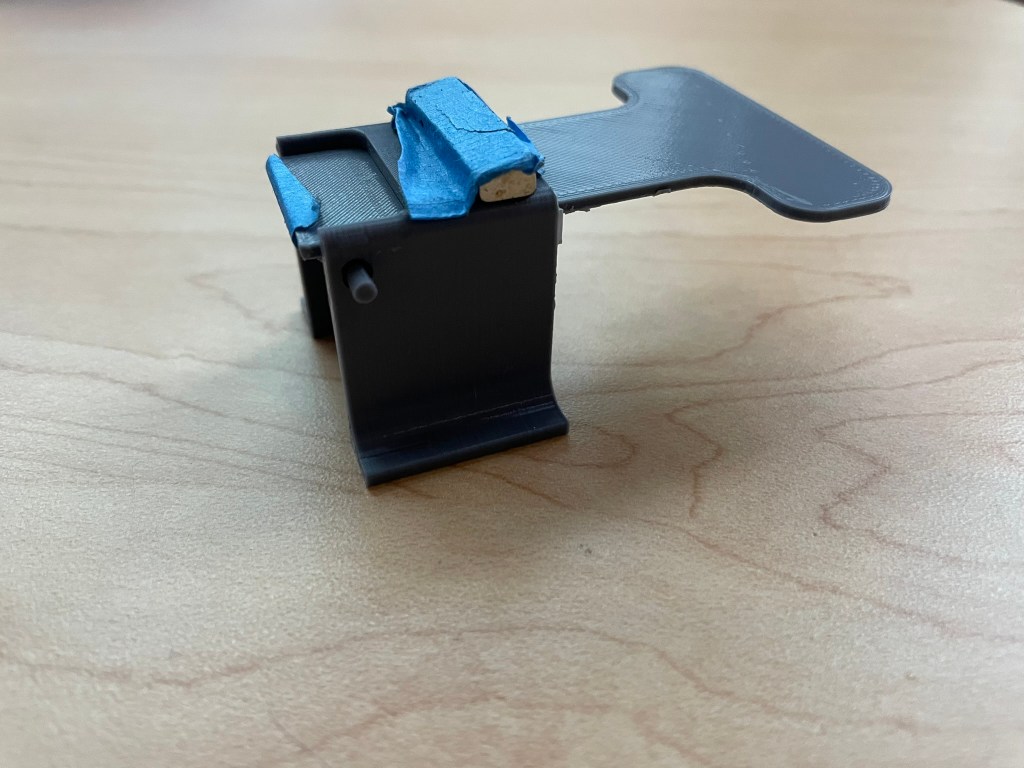
In addition, the prototypes were mounted to a dummy steering wheel of equivalent shape to validate physical spacing and confirm alignment with the lever switch. This step ensured the paddles were positioned in a place that drivers could reach easily, without interfering with any other controls, and allowed for ergonomic validation.
This comprehensive testing feedback process helped to ensure that the final paddle shifter design delivered the reliability, comfort, and confidence FSAE drivers need.
The Final Design:
Manufacturing:
The Outcome:
The new paddle shifter mechanism improved driver confidence and comfort, eliminated of mis-shifts due to tactile ambiguity, increased manufacturability, and provided higher durability for repeated race use.
 Emily Millard